validate
Check OpenAPI spec for issues that could affect generation.
validate reads your OpenAPI spec and reports what will break or degrade generation. Missing operationId? You'll get a warning — and that endpoint won't appear in api.op. Broken $ref? Error. Run this before blaming the generator.
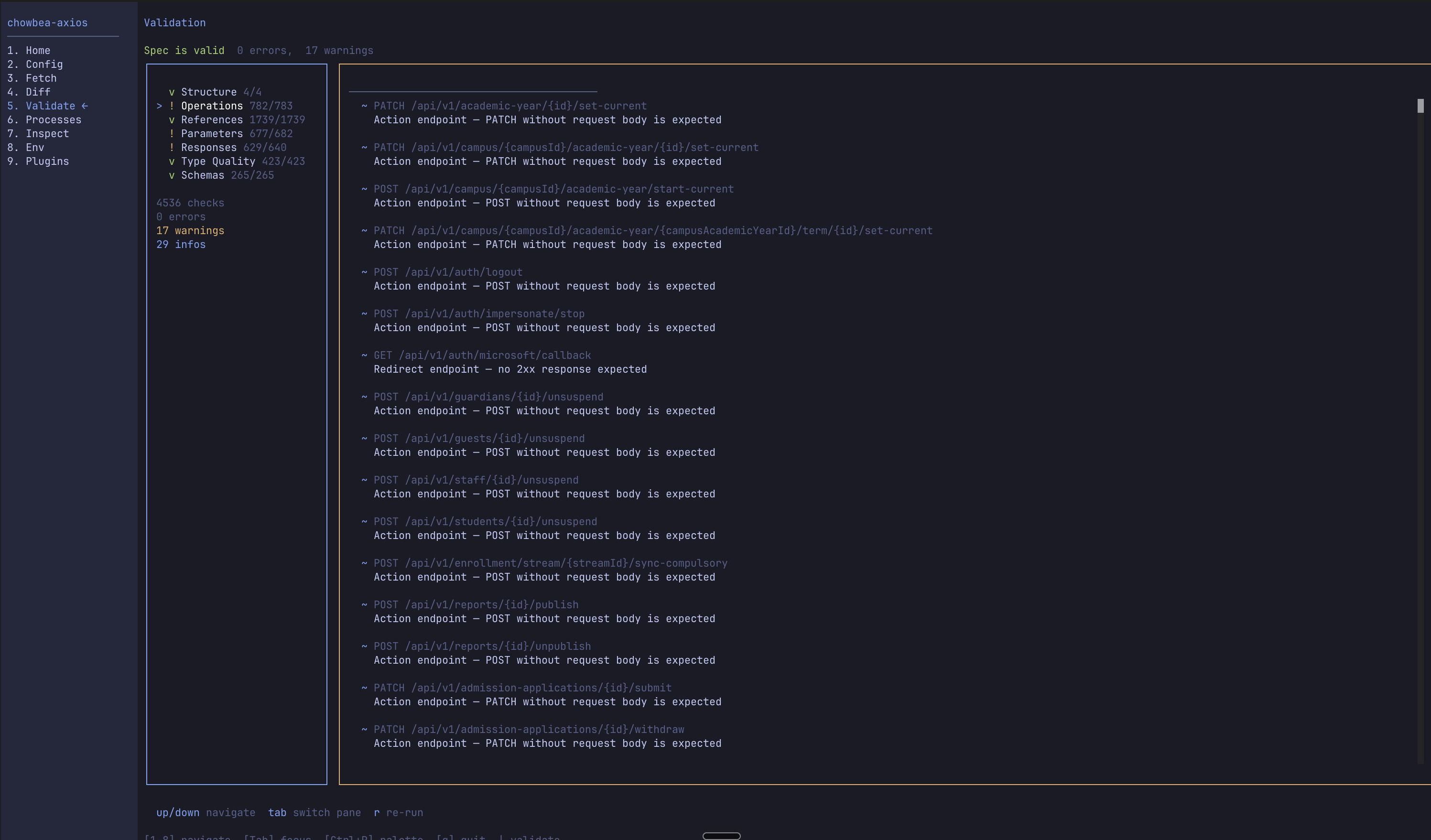 Same checks on the dashboard Validation screen — see the dashboard guide.
Usage
chowbea-axios validate [flags]What it checks
Seven categories. Each issue has severity (error, warning, info) and a JSON Pointer to the offender.
| Category | What it covers |
|---|---|
structure | Top-level required fields — openapi/swagger version, info, paths. |
operations | Every operation has an operationId and at least one response. |
references | Every $ref resolves; no circular chains beyond the configured depth. |
parameters | Path parameters declared in URLs are also declared in the operation. Query/header params are well-formed. |
responses | Response definitions are present and reference resolvable schemas. |
type-quality | Heuristics that affect generation quality — missing types, untyped any, additionalProperties: true patterns. |
schemas | Component schemas are well-formed and referenced. |
Flags
| Flag | Short | Description | Default |
|---|---|---|---|
--config | -c | Path to api.config.toml | Auto-detected |
--spec | -s | Path to OpenAPI spec file | From cache |
--strict | - | Treat warnings as errors | false |
--quiet | -q | Suppress non-error output | false |
--verbose | -v | Show detailed output | false |
Examples
Validate cached spec
chowbea-axios validateValidate specific file
chowbea-axios validate --spec ./openapi.jsonStrict mode
chowbea-axios validate --strictCI-friendly. Warnings fail the build. As they should if you care about api.op coverage.
Output
No issues
╭────────────────────────────────────────
│ chowbea-axios validate
├────────────────────────────────────────
│
│ ✓ Validating OpenAPI spec... (specPath=app/services/api/_internal/openapi.json)
│
╰────────────────────────────────────────
│
│ ✓ Validation complete (errors=0, warnings=0)
│ ✓ OpenAPI spec is valid
With warnings
╭────────────────────────────────────────
│ chowbea-axios validate
├────────────────────────────────────────
│
│ ✓ Validating OpenAPI spec...
│
├────────────────────────────────────────
│ Warnings
├────────────────────────────────────────
│
│ ⚠ Missing operationId - operation will be skipped during generation (path=/paths/users/get)
│ ⚠ Missing operationId - operation will be skipped during generation (path=/paths/users/post)
│
╰────────────────────────────────────────
│
│ ✓ Validation complete (errors=0, warnings=2)
│ ✓ OpenAPI spec is valid
Those endpoints still work on the path client. They won't get api.op methods.
With errors
╭────────────────────────────────────────
│ Errors
├────────────────────────────────────────
│
│ ✗ Missing 'openapi' or 'swagger' version field (path=/)
│ ✗ Missing required 'info' object (path=/info)
│
╰────────────────────────────────────────
│
│ ✓ Validation complete (errors=2, warnings=0)
Severity levels
| Severity | When | Behavior |
|---|---|---|
error | Spec malformed enough that generation fails or silently drops endpoints | Non-zero exit; always reported. |
warning | Generation succeeds but quality suffers (missing operationId, untyped responses) | Reported; exits non-zero only under --strict. |
info | Stylistic or low-impact notes | Reported; never fails. |
Each category shows passed / failed / total checks.
Why operationId matters
Without it:
- No
api.opmethod generated - Yes path-based call still works (
api.get("/path"))
paths:
  /users:
    get:
      summary: List users
      # missing operationId — skipped from api.operations.ts
With it:
paths:
  /users:
    get:
      operationId: listUsers
      summary: List users
If you're building The Query Layer, treat missing operationId as a spec bug, not a frontend workaround.
Use cases
Before deployment
chowbea-axios validate --strictDebugging missing operations
chowbea-axios validate"Why isn't api.op.createUser there?" — this answers that.
Validating external specs
chowbea-axios validate --spec ./external-api.jsonBefore you commit to generating against someone else's YAML.
Exit codes
| Code | Meaning |
|---|---|
| 0 | Valid (no errors, warnings allowed) |
| 1 | Errors found, or warnings found with --strict |